December sneaks up on you. One minute you’re shipping holiday orders, the next you’re staring at a calendar wondering where the year went—and whether you should be doing some kind of “business review” before it’s over.
Here’s the truth: most artists skip this entirely. Either it feels overwhelming (spreadsheets! numbers! existential dread!) or it seems pointless (I already know things were… fine? Probably?). Maybe you tell yourself you’ll figure it out during tax season. Spoiler: you won’t. You’ll be too busy panicking about receipts.
But here’s the thing—30 minutes of looking back now can save you hours of headache later. More importantly, it can save you money next year by showing you what’s actually working versus what just feels like it’s working.
This isn’t about being “good at business.” It’s about not flying blind.

Why Bother Looking Back?
I get it. You became an artist to make art, not to review quarterly metrics. But here’s the uncomfortable reality: you can’t know what’s working if you don’t actually look.
Last year, I was convinced my best-selling product was my 16×20 canvas prints. They flew off the shelf at art fairs. People loved them. I felt good about them.
Then I sat down and actually ran the numbers.
Turns out, my 8×10 matted prints—the ones I almost stopped offering because they seemed “basic”—made me nearly three times more profit per month. Lower price point, sure, but almost no shipping damage, cheaper materials, and I could knock them out quickly. Meanwhile, those canvas prints? Between the stretcher bars, the packing materials to prevent corner dings, and the time it took to package each one, my margins were embarrassingly thin.
I would have kept pouring energy into the wrong product if I hadn’t looked.
That’s the whole point of this review. Not to make you feel bad about what didn’t work, but to give you the information you need to make smarter decisions next year.
The 5 Questions That Actually Matter
Forget complicated spreadsheets and business jargon. You really only need to answer five questions. Frame them simply, and they’re not nearly as intimidating as a formal “financial review.”
1. What Did I Actually Make This Year?
Notice I said “make,” not “sell.” These are very different numbers.
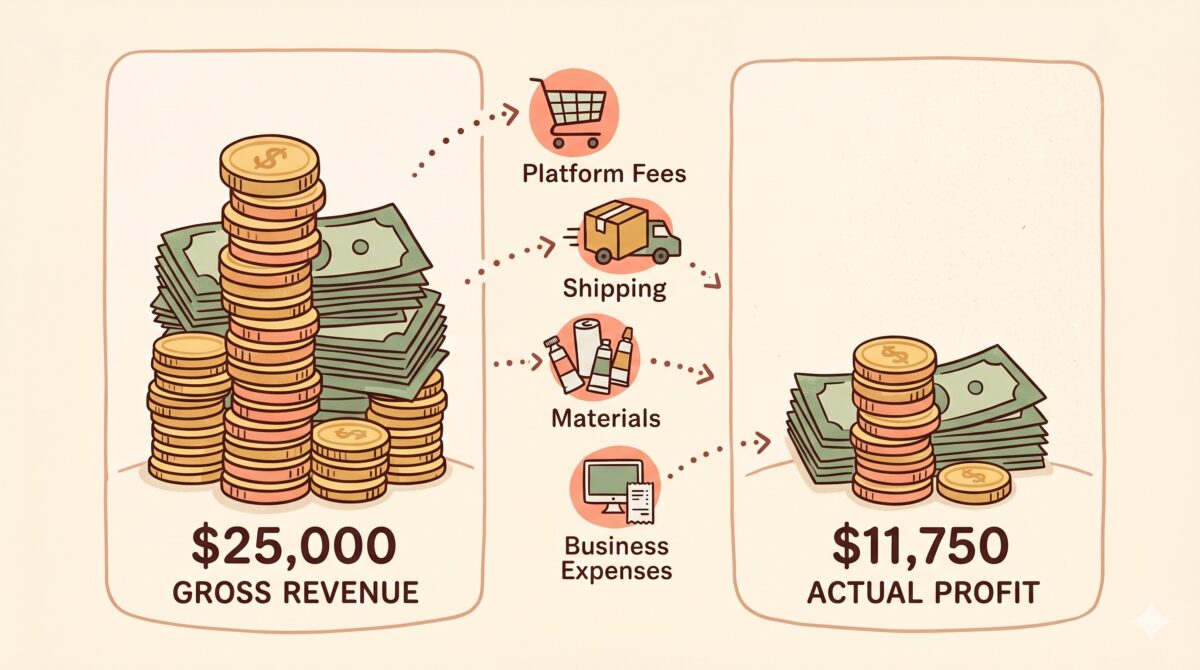
Your gross revenue—what customers paid you—is not your profit. It’s not even close. You have to subtract:
- Platform fees (Etsy takes 15%+, Fine Art America takes their cut, PayPal skims a percentage)
- Shipping costs (both what you charged and what you actually paid)
- Materials and production costs (prints, frames, packaging, shipping supplies)
- Software subscriptions, booth fees, website hosting, all of it
Let’s say you sold $25,000 worth of art this year. Feels good, right? But if platform fees ate $3,750, shipping cost you $2,500, production ran $5,000, and various business expenses added another $2,000—your actual profit is $11,750.
That’s not bad! But it’s very different from $25,000.
Knowing this number matters because it tells you what your business can actually sustain. You can’t make smart decisions about whether to quit your day job, invest in new equipment, or raise your prices if you don’t know what you’re actually taking home.
Quick calculation: Add up everything customers paid you. Then subtract everything you paid out (to platforms, suppliers, shippers, anyone). That’s your real number.
2. Which Products Made Me the Most Money?
Not most sales. Most money.
This distinction trips up a lot of artists. Volume feels good. Seeing “50 sales this month!” on your dashboard is exciting. But if those 50 sales netted you $200 in profit while a single commission earned you $800, which one actually matters more to your business?
Here’s a real example: A photographer selling on multiple platforms had these numbers last year:
- 12×18 metal prints: 45 sold, $65 profit each = $2,925 total profit
- Digital downloads: 230 sold, $4 profit each = $920 total profit
- 8×12 paper prints: 85 sold, $12 profit each = $1,020 total profit
- Custom framed pieces: 8 sold, $175 profit each = $1,400 total profit
The digital downloads looked like the winner based on volume. They weren’t even close. The metal prints generated three times the profit with a fraction of the transactions.
The question isn’t “what sells?” It’s “what earns?”
Go through your products and figure out your profit margin on each. Then multiply by how many you sold. The results might surprise you.
3. Which Platform Performed Best?
If you’re selling on multiple platforms—Etsy, Shopify, Fine Art America, your own website, art fairs—you need to know which ones are actually worth your time.
But here’s where it gets tricky: you can’t just compare gross sales. Platforms have wildly different fee structures, and some costs are hidden until you do the math.
For self-fulfilled sales (where you handle printing, packing, and shipping), you need to factor in:
- Platform and payment processing fees
- Printing/production costs
- Packaging materials
- Actual shipping costs (not just what you charged)
For print-on-demand platforms (where they handle fulfillment), your margin is built into the pricing structure—but that doesn’t automatically mean it’s worse. Depending on the platform and product, POD margins can be surprisingly competitive with self-fulfillment, especially when you factor in your time and the true cost of shipping mishaps, damaged prints, and customer service headaches.
The trap most artists fall into is assuming the platform with the highest sales volume is the best performer. But a platform that generates $5,000 in sales with $3,500 in profit is outperforming one that generates $8,000 in sales with $2,500 in profit.
Do this: For each platform you sold on this year, calculate your total revenue minus every associated cost. Then divide by the hours you spent managing that platform. The results might reshape where you focus next year.
4. What Did I Spend Money On—and Did It Pay Off?
Artists often track income but ignore expenses until tax time. Then it’s a scramble through bank statements and crumpled receipts.
Take 20 minutes and categorize what you spent on your art business this year:
- Materials & supplies: paper, ink, canvas, frames, packaging materials
- Production: printing costs, framing, lab fees
- Shipping: postage, boxes, mailers, tape, labels
- Software & subscriptions: website hosting, email marketing, editing software, accounting tools
- Marketing: booth fees, paid ads, business cards, signage
- Education: workshops, courses, books
Now ask yourself: did each category earn its keep?
That $500 booth fee for the summer art fair—how much did you sell? If you made $2,000 in sales with $800 profit, that booth fee looks good. If you made $400 and broke even after gas and hotel, maybe skip that show next year.
That $300/year software subscription you barely use? Cancel it.
That $150 in Facebook ads that generated zero attributable sales? Don’t repeat that experiment.
This isn’t about being cheap. It’s about investing in what actually moves the needle.

5. What Should I Do Differently Next Year?
Based on the answers above—not vibes, not gut feelings, but actual information—what changes should you make?
Maybe it’s:
- Doubling down on your most profitable product
- Dropping a platform that takes too much and gives too little
- Skipping that art fair that consistently underperforms
- Raising prices on products where your margins are too thin
- Investing more in what’s working (better booth setup, more inventory of winners)
Keep it simple. Pick one or two concrete changes. “Be better at business” isn’t a goal. “Raise print prices by 15% in February” is.
How to Actually Find This Information
Okay, so you’re convinced this matters. But where do you even find these numbers?
If You Have a Spreadsheet (Even a Messy One)
Pull out your totals:
- Sum of all revenue (what customers paid)
- Sum of all fees and costs (what came out)
- Subtract the second from the first
Then sort by product type and platform to see where your money actually came from.
If You Have Nothing (Just Vibes and Anxiety)
Start with what’s easy:
- Platform dashboards: Etsy, Fine Art America, and Shopify all have basic analytics. Pull your total sales and fee summaries.
- Bank statements: Filter for business transactions. Add up deposits (revenue) and business-related payments (expenses).
- Payment processors: PayPal, Square, and Stripe all offer year-end summaries.
It won’t be perfect. You’ll miss some expenses. That’s okay. An imperfect review is infinitely better than no review.
I’ll be honest with you: this process is painful if you don’t have a system. Finding all this information across multiple platforms, piecing together receipts, and trying to figure out which products actually made money versus just felt popular—it’s genuinely tedious.
That friction is exactly why most artists skip this. And why they keep making the same unprofitable decisions year after year.
What to Do With What You Learn
Information is useless if you don’t act on it.
Double down on what’s profitable. If your metal prints are killing it, make more designs, feature them more prominently, create bundles around them.
Reconsider what isn’t. That product line with razor-thin margins? Either raise the price, find cheaper production, or phase it out. Your time and energy are limited.
Set one or two concrete goals for next year. Not vague aspirations—specific targets.
Examples:
- “Increase average order value from $45 to $60 by adding frame upsells”
- “Launch 10 new designs for my metal print line by March”
- “Reduce platform dependency by driving 25% of sales through my own site”
Write them down. Put them somewhere you’ll see them in February when motivation is fading.
Make Next Year Easier
Here’s the best piece of advice I can give you: the easiest time to start tracking is January 1.
Starting fresh with a new system—even a simple one—means next December’s review takes minutes instead of hours. You’ll know your numbers in real-time, not just once a year when you force yourself to dig through the chaos.
This is actually why I built BizyBee. After too many Decembers spent hunched over spreadsheets, trying to reconcile sales across Etsy, Fine Art America, and art fairs, I wanted a tool built for how artists actually work. One place where I could see what’s really selling, what’s really profitable, and which platforms are earning their fees.
If you want next year’s review to take five minutes instead of five hours, you might want to check it out. There’s a free tier, so you can see if it works for you before committing anything.
The Bottom Line
Even 30 minutes of reviewing your year puts you ahead of most artists who never look at all. You don’t need to be a business expert. You don’t need fancy software (though it helps). You just need to be willing to look at the real numbers instead of the story you tell yourself about your business.
The artists who grow steadily, year after year? They’re not necessarily more talented or more lucky. They just pay attention to what’s actually happening—and adjust accordingly.
Take 30 minutes this week. You’ve got this.