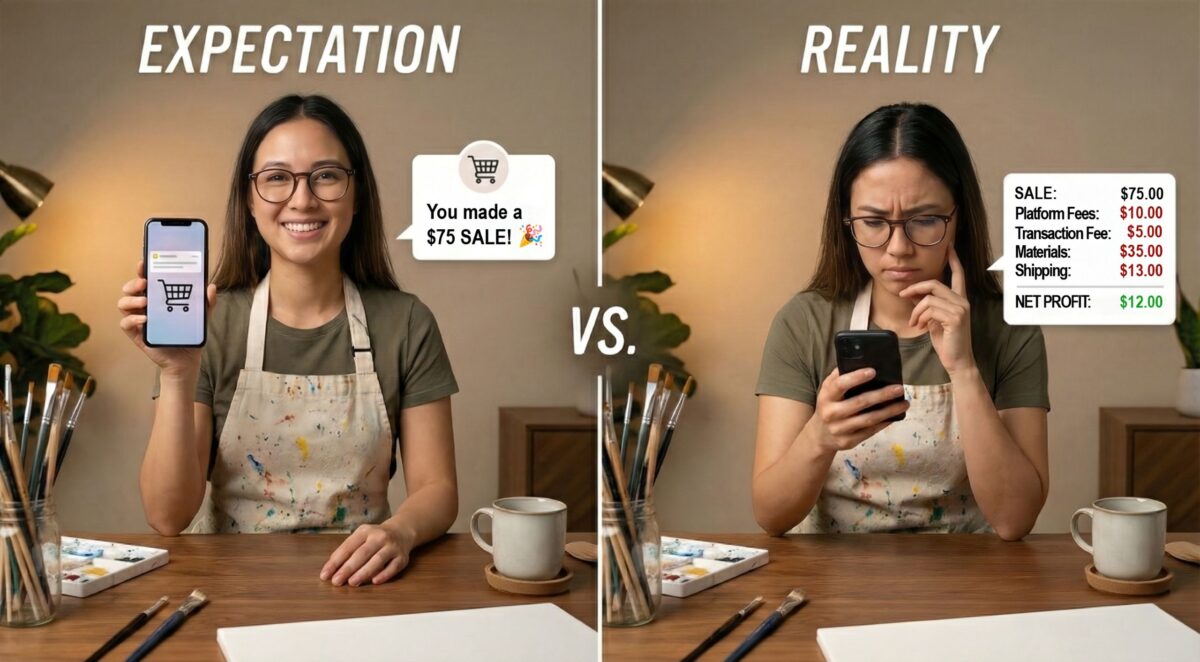
You wake up to a $55 sale notification. Feels great—until you start doing the math. The platform takes their cut. Payment processing fees hit. Subtract fees, shipping, materials, and packaging.
You made $18. Platform fees for artists vary wildly depending on where you sell.
This isn’t a cautionary tale. It’s Tuesday for most artists selling online.
The goal of this post isn’t to scare you away from any platform. It’s clarity. When you understand what each marketplace actually costs, you can make informed decisions about where to focus your time and energy.
Why Platform Fees for Artists Matter More Than You Think
A 5% difference in fees across 500 sales can mean hundreds of dollars in your pocket—or theirs.
Many artists choose platforms based on ease of use or where the audience already exists. That’s a valid strategy. But you should know the tradeoff you’re making.
You can’t optimize what you don’t understand, so you have to track sales across platforms.
Etsy: The Fee Breakdown
Etsy’s fee structure has multiple layers, and they all add up. Here’s what you’re actually paying (at time of writing):
Listing Fee: $0.20 per listing
Listings stay active for 4 months or until sold. When an item sells, the listing auto-renews for another $0.20. Multi-quantity listings? You pay $0.20 for each unit sold.
Transaction Fee: 6.5% of total order
This applies to everything the buyer pays: item price, shipping, and gift wrap. Not just the product price.
Payment Processing Fee: 3% + $0.25 per transaction (US sellers)
This covers credit card processing through Etsy Payments. Rates vary slightly by country.
Offsite Ads Fee: 12-15% (when triggered)
If a buyer finds your listing through Etsy’s advertising on Google, Facebook, or other platforms and purchases within 30 days, you pay this fee. Shops earning under $10K/year pay 15%. Over $10K? It drops to 12%, but you can’t opt out.
Currency Conversion Fee: 2.5%
Only applies if you accept payment in a currency different from your payout currency.
Setup Fee: $15-29 (one-time, not everyone pays)
Etsy introduced this for some new sellers. You’ll see it during signup if it applies to you.
Example: $50 Item + $5 Shipping = $55 Total
| Fee Type | Amount |
|---|---|
| Listing fee | $0.20 |
| Transaction fee (6.5%) | $3.58 |
| Payment processing (3% + $0.25) | $1.90 |
| Total fees | $5.68 |
That’s 10.3% of your sale price in fees alone.
Now add Offsite Ads. If that sale came from an ad click:
| Fee Type | Amount |
|---|---|
| Offsite Ads (15%) | $8.25 |
| New total fees | $13.93 |
That’s 25.3% gone before you’ve counted materials, packaging, or actual shipping costs. This is why understanding platform fees for artists isn’t optional.
Let’s say the item cost you $15 to make, packaging was $2, and actual shipping was $6. Your “profit” on that $55 sale notification?
$55 – $13.93 (fees) – $15 (materials) – $2 (packaging) – $6 (shipping) = $18.07
Without Offsite Ads, you’d keep $26.32. That $8.25 difference adds up fast across multiple sales.
You can verify current rates on Etsy’s official fee policy—they update periodically.
Fine Art America: The Markup Model
Fine Art America works completely differently. No per-transaction fees. No payment processing charges. Just one simple (and often misunderstood) model.
How it works:
FAA sets a base price for every product—canvases, metal prints, phone cases, everything. This base price covers manufacturing, shipping to the customer, and FAA’s margin.
You add your markup on top. Whatever markup you set is exactly what you earn.
Costs:
- Standard membership: Free (up to 25 images, but not for sale)
- Premium membership: $30/year (unlimited images, custom website, marketing tools)
That’s it. No commission, payment processing fees, or transaction fees. But read on…
Example: Canvas sells for $80
| Component | Amount |
|---|---|
| FAA base price | $50 |
| Your markup | $30 |
| You receive | $30 |
Simple, right?
Here’s the catch no one talks about: FAA runs frequent site-wide promotions—20% off, 30% off, sometimes 50% during major holidays. When those discounts apply, they typically come from your markup, not FAA’s base price.
FAA also offers an opt-in Google Ads program where they market your work. Sounds great—until you realize sales from those ads cost you 50% of your markup. That $30 canvas markup becomes $15 if the buyer clicked a Google ad.
On that $80 canvas with a 20% site-wide discount:
- Buyer pays $64
- FAA still covers their base cost ($50)
- You receive $24 instead of $30
That 20% “site-wide” discount cost you earnings on that sale, not FAA.
Volume buyers and trade discounts can cut even deeper. If you’ve opted into certain promotional programs, your take-home can shrink significantly during high-traffic sale periods—precisely when you’re making the most sales.
The nuance: FAA handles printing, shipping, customer service, and returns. You upload an image and collect checks. For many artists, that tradeoff is worth it. Just understand what you’re trading.
Factor in your time: Uploading images, writing descriptions, keywording for search, managing your portfolio. That labor has value even when there’s no line item for it.
FAA explains their markup model on their pricing tour page.
Shopify: The Subscription Model
Shopify flips the script. Instead of high per-transaction fees, you pay a monthly subscription and get lower processing rates.
Monthly Plans (current pricing):
| Plan | Monthly Cost | Processing (Shopify Payments) |
|---|---|---|
| Basic | $39/month | 2.9% + $0.30 |
| Grow | $105/month | 2.6% + $0.30 |
| Advanced | $399/month | 2.4% + $0.30 |
Key detail: If you use Shopify Payments, there’s no additional transaction fee. Use a third-party payment processor like PayPal, and Shopify adds 2% (Basic), 1% (Grow), or 0.6% (Advanced) on top of whatever that processor charges.
Example: Same $50 Item + $5 Shipping
| Fee Type | Amount |
|---|---|
| Payment processing (2.9% + $0.30) | $1.90 |
| Monthly subscription (amortized) | Varies |
| Per-transaction fees | $1.90 |
Looks great compared to Etsy’s $5.68. But that monthly subscription changes the math.
If you sell 10 items per month on the Basic plan, that $39 subscription adds $3.90 per sale. Now you’re at $5.80—basically the same as Etsy.
If you sell 100 items per month? That $39 spread across 100 sales is only $0.39 per item. Now you’re at $2.29 per sale—a significant savings.
The hidden costs:
- Email marketing, reviews, print-on-demand integration—you can easily spend $50-100/month on add-ons.
- Themes beyond free options cost $180-350 (one-time).
- Your domain costs extra ($15-20/year typically).
The real cost: Shopify is cheaper per transaction but requires volume to make the fixed costs worthwhile. And unlike Etsy or FAA, you bring all your own traffic.
Check Shopify’s current pricing as plans and rates change.
Other Platforms (Quick Reference)
Redbubble / Society6
Similar to FAA: they set base prices, you set markup, you keep markup. No transaction fees, but lower price control and marketplace-dependent traffic.
Amazon Handmade
15% referral fee on each sale. No monthly fee. Massive audience, but you’re competing with Amazon’s own recommendations and algorithm.
Your Own Website (non-Shopify)
Payment processing only (typically 2.9% + $0.30). You handle traffic, fulfillment, and customer support. Highest margins, highest workload.
The Real Question: Where Should You Sell?
This isn’t about picking one platform. It’s about understanding each one so you can make strategic choices.
High-traffic marketplaces (Etsy, FAA):
- Lower profit per sale
- Built-in audience
- Less marketing work required
- Platform controls your visibility
Your own site (Shopify, standalone):
- Higher profit per sale
- You build and own the audience
- More control, more responsibility
- Fixed costs require volume to justify
Many successful artists do both intentionally: use marketplaces for discovery and volume, funnel repeat customers to their own site for better margins.
The key insight: Know your actual margin on each platform so you can decide where to focus energy.
We didn’t even get into the joys of tax season and Schedule C reports!
How to Track Platform Fees for Artists Without Losing Your Mind
You could calculate fees manually for every sale. Spoiler: you won’t. Life gets busy. Sales come in. You’ll check your bank account, feel good or bad about the number, and move on.
Spreadsheets work until they don’t. Copying sales data, plugging in fee formulas, remembering which sale came from which platform—it becomes a second job.
I built BizyBee specifically because I wanted to see my real profit by platform without doing math every time I made a sale. Import your sales data, set your costs, and see exactly what you’re keeping across Etsy, FAA, Shopify, art fairs—wherever you sell.
See exactly how much each platform is really costing you.
The Bottom Line
Marketplaces aren’t ripping you off. They’re charging for access to their audience, their infrastructure, and their trust with buyers. Whether that’s worth it depends entirely on your situation.
But you deserve to know exactly what you’re paying for that access. Only then can you decide if it’s worth it.
Have questions about fee structures or want to see how your current sales stack up across platforms? Drop a comment or reach out—I’m happy to help you run the numbers.